Professional Repair and
Shop Operation Class
Friday, December 2, 2005
Derailleurs
Previous | NextMy goal was to read the text in the UBI workbook for the following day's lesson. I never did get caught up after the first day, since we didn't receive the book until after we had covered the first chapter. Since I felt I knew much of the basic material that was being covered, I tended to skip over some of the text. Plus it was too easy to sit around and b.s. with the hostel mates instead of studying, as there weren't many other people hitting the books.
Derailleur and brake adjustments are probably the most frequently conducted repairs in most shops.
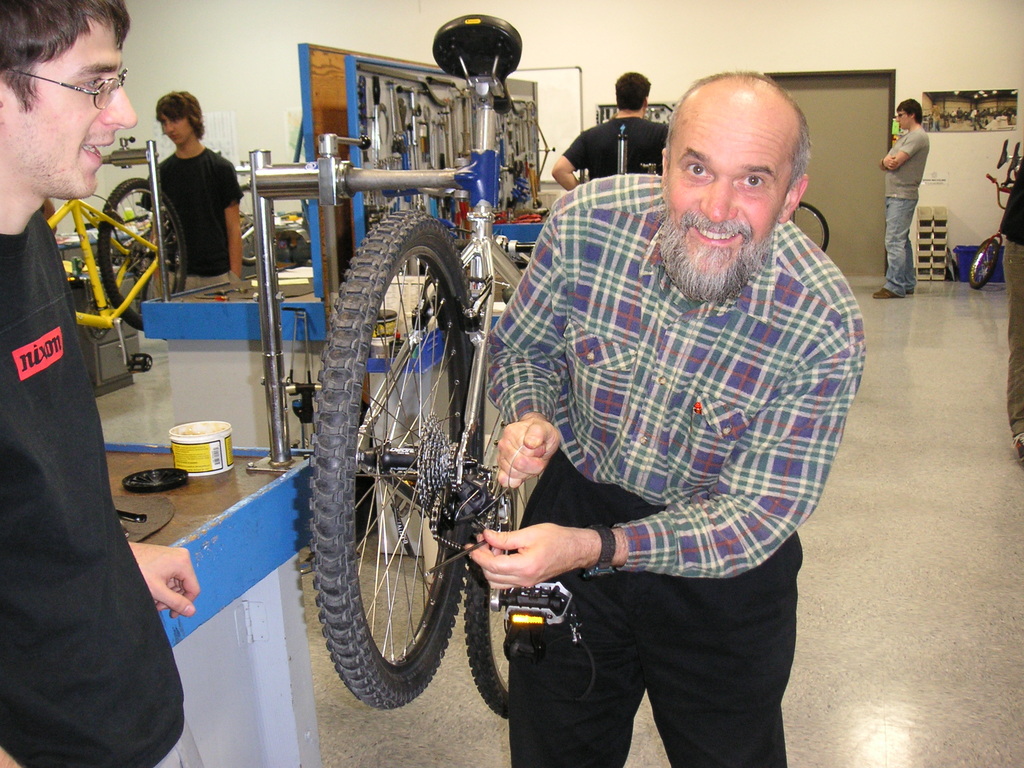 |
| Mark and Erich |
While the front derailleur is simpler than the rear, adjusting the front can be difficult. There seem to be very low tolerances for a mis-aligned cage or improper cable tension. It really is an art to properly adjust a front or rear derailleur, and we had lots of practice doing both.
We also removed and installed cables and housings, but didn't get a chance to work on some of the trickier, older SRAM grip shift mechanisms. They are somewhat of a puzzle. There are a great variety of types, so replacing a worn cable can be difficult depending on how circuitously the cable is routed. The newer shifters have a much better design than the older ones.
On the first Friday of each month the art galleries and fine art gift shops in Ashland hold extended hours for an art walk, hosted by A Taste of Ashland, the Ashland art gallery association. Most galleries are open until 8 or 9 pm and they provide wine and snacks, often with artists present to discuss their work.
Soon after class ended I walked into town to check out some of the galleries. At the Hanson Howard Gallery there was a large crowd milling around. There were some nice works displayed, including a book of drawings by Kevin Christmore (Christmare? It's difficult to read the gallery person's handwriting). I then walked over to the Railroad District to visit the Davis & Cline galleries located in two beautifully renovated buildings.
The Railroad District developed with the advent of the railroad line that connected areas to the north with California in the south. The area around the rail station developed in the late 1880's to provide services to the railroad. When the main line of the railroad shifted to the east in 1927, the railroad district boom was over and the area was dormant until the recent revival in the late 1990's.
I also wanted to attend the jazz concert being conducted by the music professor who had guided me into Ashland during my ride from Medford. The Jazz Band put on a good concert, minus a few sour notes from the brass section. The alto sax player, pianist and the percussionists were excellent, several of them having played together at Ashland High School.
Previous | Next